Private AI deployment services
Private AI, engineered
around your environment.
Run models on your hardware or inside your cloud account, connected to the work your team needs to do.
Discuss your deployment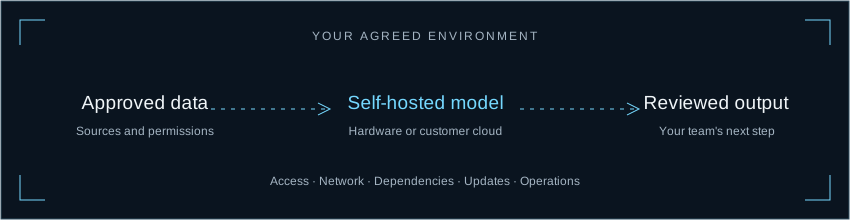
Start with fit
A reason to run it privately.
A private deployment makes sense when there is a concrete requirement: restrictions on external inference, local operation, integration with controlled systems, predictable capacity, or a workload that merits dedicated infrastructure.
We establish the task, the data owner, expected usage and the current alternative before choosing a model or sizing hardware. Sometimes an existing product or a provider-hosted model is the better fit.
Typical starting points include an internal knowledge assistant or a document preparation workflow. We begin with one team and a bounded set of inputs.
Where it runs
Two private deployment paths.
On customer-owned hardware
We assess the compute, storage and network needed for your workload, then scope installation, model serving, application integration and recovery. Offline or air-gapped operation requires an explicit design for installation, updates and support.
Inside your cloud account
Self-hosted inference runs on infrastructure you control. We define regions, network access, identity, storage, logging, backups and operating responsibility. Your cloud bill continues; capacity and access need active management.
When frontier-model access is appropriate
We can connect applications to a model provider or managed inference service when approved data flows and capabilities fit. The provider processes those requests, and token pay-per-use remains. This is a separate deployment choice with its own data boundary.
What Hydra does
From the first workload to ongoing operation.
- Establish requirements. Map the workflow, approved data, users, current tools, usage and success criteria.
- Design and evaluate. Test candidate models on representative tasks, including uncertainty, access restrictions and failure cases.
- Deploy and integrate. Connect approved systems, implement review and error handling, test the workflow and document the configuration.
- Handover and operate. Agree monitoring, updates, backup/recovery, support access and responsibility for changes.
Assessment, implementation and continuing support are scoped separately. Hardware, cloud capacity, storage, software licensing and any external model use are separate cost components.
Control in practice
Define the whole data path.
We account for document processing, embeddings, model inference, logs, backups and support access. A locally hosted model alone does not establish that every part of a system is private.
- Approved sources, document ownership and access permissions.
- Allowed network connections and external dependencies.
- Software/model downloads, telemetry and update review.
- Administrative access, retention and recovery procedures.
Security and compliance requirements need an agreed scope and evaluation. An on-premises installation is not a compliance certification.
Before we start
Useful questions.
Do we need to buy GPUs first?
No. Start with the task, expected workload and a model evaluation. Hardware selection follows the capacity and operational requirements.
Does self-hosting mean no recurring costs?
No. Hardware, energy or cloud compute, storage, software and operations still cost money. Self-hosted inference can remove dependence on a metered third-party model API for that model.
Can you guarantee a model will meet our requirements?
We agree evaluation cases and acceptance criteria before implementation. Model suitability, quality and capacity must be measured for your workload.
Define the first workload
What needs to run
inside your environment?
Tell us the task, who uses it and the control requirement. A high-level description is enough to begin.
office@hydragroupllc.comEngineering-led delivery
Hydra is led by a principal-level engineer with 12 years building software at startups. We agree a secure way to review confidential material separately.